
“If You Own A Business, There's A Question You've Had Since You Started...
What Should I Pay Myself?”
Watch Video Below For Details And Act Now!

From the Enrolled Agent who calculates reasonable compensation for S-Corp owners...
...showing you how the IRS actually calculates your salary, job by job, hour by hour, and how to prove it with a report you can hand the IRS if they ever question your number.
Launch Price Ends Sunday, November 15th at 10 pm Eastern
Dear Friend,
If you own a business, there's likely a question you've had since you started...
and you still don't know the answer.
That question is...
What should I pay myself?
Now, you've likely been given some bad advice that seemed like a good answer.
You can pay yourself a percentage of your profit... likely somewhere between 40-60%.
Or max out your Social Security wages...
or... $60,000 seems reasonable.
They seem logical in some cases, right?
So what's wrong with them?
Well... the IRS doesn't use any of them. And if you do... they can't be defended in an audit.
It's very rare that I've found an owner within $5,000 of a true reasonable salary...
And most owners are currently either overpaying or underpaying their payroll taxes from as little as $2,000 to $20,000 per year.
Now, if you've read my S-Corp Tax Savings Guide, you're likely familiar with the simplified version of this concept.
Today, I'm going to go deeper into that method and pull back the curtain on how you calculate your own reasonable compensation... step-by-step.
Why Should You Even Listen To Me?
I'm Barry Roach, and I've been an Enrolled Agent since 2016, which means I specialize in tax and am licensed to represent you in front of the IRS.
Barry Roach, EA
Here's something that most people might try to hide from you.
I was actually taught the 50% of profit method for setting your salary as I came up as an accountant.
Then, in December 2024, I was sitting in my car outside the YMCA while my son was inside at basketball practice.
I was watching my annual continuing education at the last minute... like most busy owners do.
I decided to take a training on reasonable compensation that caught my attention.
I was intrigued, as this wasn't normally talked about much in the industry.
And boy, did it open my eyes. They didn't use profit or percentages at all. They shared the way the IRS actually calculates it.
Based on the actual work you do in your business... job by job... hour by hour. Basically, what you'd pay someone else to do those jobs for you hourly.
This was the biggest "aha" moment of my career. And it's the reason Business IQ Edge exists today.
I made it my mission to educate business owners and accountants on this method. Because not only does the IRS require you to do it correctly...
but it can also be the single biggest and cheapest tax savings lever you can pull in your business if you're overpaying yourself.
Here's What The IRS Actually Looks At...
It's Not Your Profit.
Secret number one. Your profit has nothing to do with your salary.
Whether you profit $30,000 or $800,000 per year.
Say you run a plumbing company. When you set out to hire your new tech, is their salary based on your company's profits or the hours they're going to work?
I'm not talking about the rate you're going to pay them. I mean the hours they are going to work for you.
Let's say you'd pay a plumber on your team $40 per hour. If that plumber works 40 hours per week, you'd pay them $1,600 in wages per week, right?
Are you with me so far?
Now, what if you don't need someone for 40 hours per week? What if you only need them for 10 hours per week?
Are you paying them $1,600 for 40 hours, or are you paying them $400 for 10 hours?
That is exactly what the IRS is looking at for the work you do... not your profit.
“I Wouldn't Even Know Where To Look”
If You Can Get Dressed In The Morning, You Can Do This.
Secret number two. You don't need to know tax law to get this right.
Most business owners I talk to say the same thing: "I wouldn't even know where to look."
This is consistent across all industries. From dog poop scoopers, to roofers, to attorneys, to doctors.
If you can follow step-by-step instructions and use a computer, you can calculate your salary.
And to be clear, we aren't talking about assembling IKEA furniture here.
More like how to get dressed in the morning.
It's literally: start here, then do this, then do this, type in this here, then do this.
Safe On The Return...
Or Defensible In An Audit?
Secret number three. Everyone you ask gives you a different answer.
And you're not wrong.
This might be controversial, and it might not be what you want to hear.
Do you care more about the number looking safe on the return to possibly avoid an audit?
Or do you care more about having an accurate number you can defend in an audit?
I'm not going to tell you which one you have to choose... but I'll tell you which one I advise my clients to use.
It's important to know if your salary is off, it can cost... or save you roughly 20% in taxes.
A business owner I worked with to calculate his reasonable compensation was profiting around $300,000 per year. So if he wanted to play it safe and fly under the radar, he could probably use a salary of $120,000-$180,000 and get away with it.
But... when I calculated his reasonable compensation, it came in around $18,000 due to how little he works in the business.
So for round numbers, $100,000 lower salary, from $120,000 down to $18,000, will save him about $20,000 per year in taxes.
So would you rather pay the IRS an additional $20,000 per year...
or hand them your calculation and keep that $20,000 in your pocket every year?
So I built an app for you to use as well. You plug in your numbers, and it prints a report. If the IRS ever questions your salary, you hand them the report.
Introducing RC Mastery
And I've included it as part of the RC Mastery course.
The course totals just shy of 2 hours and is split into mini modules that walk you through your own reasonable compensation calculation. A value of $197.
You'll also get access to the RC Calculator app, where you can enter your job duties, hours, and rates, and it will populate a professional report you can keep on file and confidently hand to the IRS if you'd ever need to. A value of $199.
And you'll also get access to the S-Corp Stress Test. Whether you're an S-Corp already or want to know if an S-Corp makes sense for you... you simply plug in your profit, your current salary, and your newly calculated salary. And it's going to show you your potential tax savings or potential tax liability. A tax planning call with an accountant to give you these numbers will run you anywhere from $150 to $500. A value of $97.
That's $493 in total value.
But I'm not going to charge you $493.
Heck, I'm not even going to charge you half of that.
You'd normally need to invest $97 to access this course.
But until Sunday, November 15th at 10 pm Eastern, you can get access at our special launch rate of only $47.
Let's Add This Up
Here's Everything You're Getting:
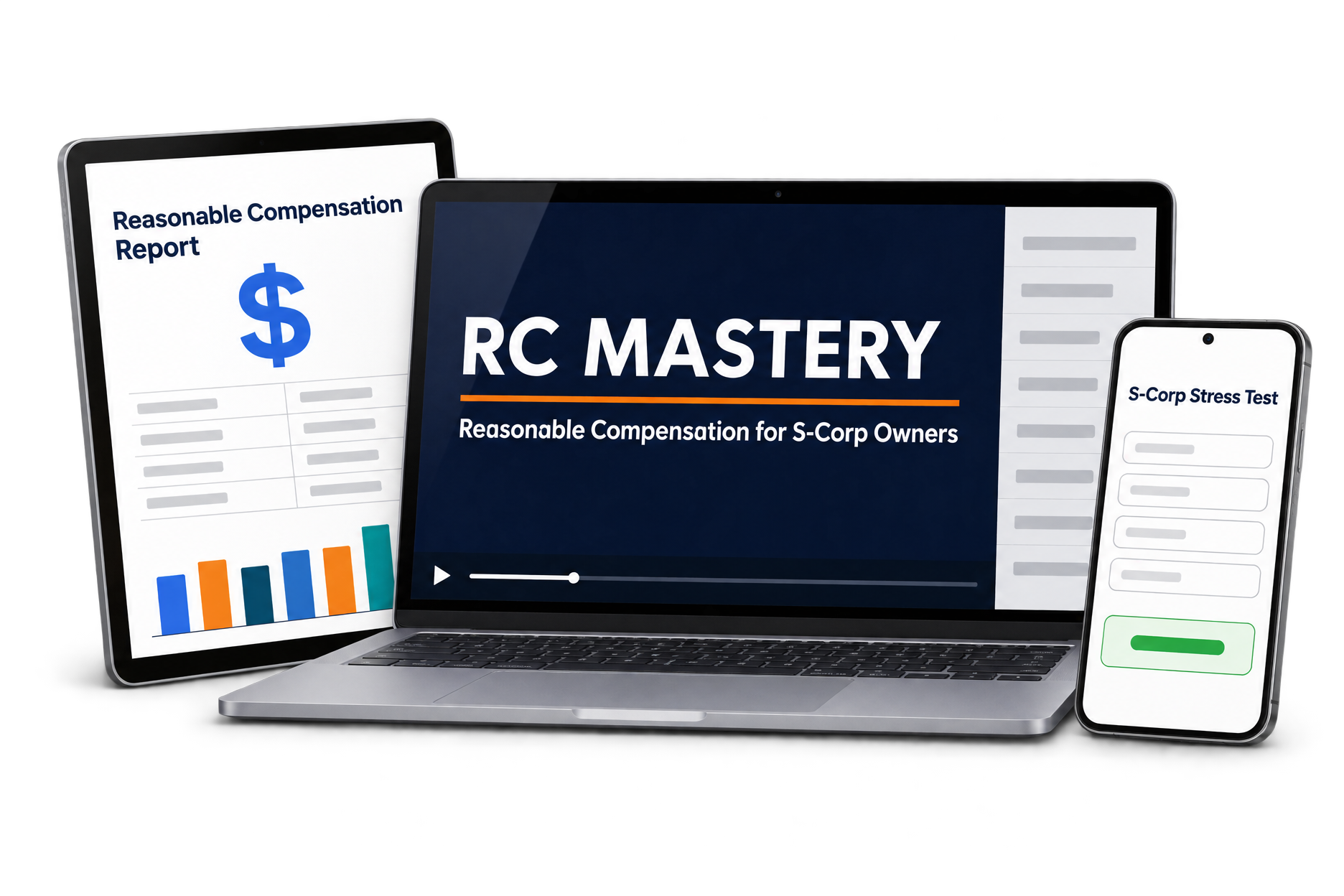
- RC Mastery Course (Just Shy Of 2 Hours)$197
- RC Calculator App + Professional Report$199
- S-Corp Stress Test$97
TOTAL VALUE $493
Your Investment Today:
$97 $47
Launch Price. Ends Sunday, November 15th at 10 pm Eastern.
Values based on what comparable courses, salary software and tax planning calls sell for.
Now, I want to be sure you understand your potential savings or liability.
Less than 10% of people I've calculated this for have been within $5,000 of a true reasonable compensation. And being off just $5,000 costs you roughly $900 per year in taxes.
And if you want to pay me to calculate this for you, I charge $497 for that service.
But today, I'm going to show you how to do this yourself for only $47.
Lifetime Money-Back Guarantee:
I'm Insisting You Get The Result You Paid For
Now, you might be thinking...
What if this doesn't work for me?
What if it's too hard?
Or what if I get the same number I'm already using today for my salary?
I buy things too. I know I ask these same types of questions.
And that's why this course comes with my lifetime money-back guarantee.
When you finish this course, you will have your salary calculated, and you will be able to show exactly how you calculated it. That's the result you're paying for, and that's the result I expect.
If for any reason you do not get that result, you're going to get your money back. You are going to send me an email at [email protected] and tell me it didn't work.
You'll keep the course and the app, and I'll refund you every penny within 24 hours. No questions asked.

I'm not asking you to be satisfied. I'm insisting you get the result you paid for.
Now, remember that the profit of your business has nothing to do with your salary. It's based completely on the work you do.
You don't need to know tax law to calculate your salary. You just need to be able to describe what you do in your business and how much time you spend doing it.
And the goal is not to put a number on your return that won't raise a red flag. Your job is to prove how you came up with your salary number.
This course shows you the full method, with a few secret levers I haven't shared today.
The app will do the math for you, and it prints the report for your proof.
And the Stress Test Calculator will show you what that means for your bank account. Good or bad.
Right Now, You've Got Two Options.
You can keep the number you're using today and keep using a method that can't be defended in an audit. Maybe it's right, or close enough. Or maybe you're looking at a tax bill from the IRS with interest and penalties you weren't ready for.
Or you can click the button below. Take advantage of our special launch discount, and invest $47 and a few hours of your time.
If you choose option 2, click the button below, enter your information, and I'll see you in Module 1 in the next few minutes.
Talk soon,
Barry Roach
Barry Roach, EA
Enrolled Agent · Founder, Business IQ Edge
P.S. Remember, the profit of your business has nothing to do with your salary. It's based completely on the work you do. The course shows you the full method, and the app prints the report for your proof.
P.P.S. You're covered by my lifetime money-back guarantee. If you don't finish with your salary calculated and the ability to show exactly how you calculated it, email me. You keep the course and the app, and I'll refund you every penny within 24 hours.
P.P.P.S. The $47 launch price ends Sunday, November 15th at 10 pm Eastern. After that, the course is $97.
Dear Friend,
If you own a business, there's likely a question you've had since you started...
and you still don't know the answer.
That question is...
What should I pay myself?
Now, you've likely been given some bad advice that seemed like a good answer.
You can pay yourself a percentage of your profit... likely somewhere between 40-60%.
Or max out your Social Security wages...
or... $60,000 seems reasonable.
They seem logical in some cases, right?
So what's wrong with them?
Well... the IRS doesn't use any of them. And if you do... they can't be defended in an audit.
It's very rare that I've found an owner within $5,000 of a true reasonable salary...
And most owners are currently either overpaying or underpaying their payroll taxes from as little as $2,000 to $20,000 per year.
Now, if you've read my S-Corp Tax Savings Guide, you're likely familiar with the simplified version of this concept.
Today, I'm going to go deeper into that method and pull back the curtain on how you calculate your own reasonable compensation... step-by-step.
Why Should You Even Listen To Me?
I'm Barry Roach, and I've been an Enrolled Agent since 2016, which means I specialize in tax and am licensed to represent you in front of the IRS.
Barry Roach, EA
Here's something that most people might try to hide from you.
I was actually taught the 50% of profit method for setting your salary as I came up as an accountant.
Then, in December 2024, I was sitting in my car outside the YMCA while my son was inside at basketball practice.
I was watching my annual continuing education at the last minute... like most busy owners do.
I decided to take a training on reasonable compensation that caught my attention.
I was intrigued, as this wasn't normally talked about much in the industry.
And boy, did it open my eyes. They didn't use profit or percentages at all. They shared the way the IRS actually calculates it.
Based on the actual work you do in your business... job by job... hour by hour. Basically, what you'd pay someone else to do those jobs for you hourly.
This was the biggest "aha" moment of my career. And it's the reason Business IQ Edge exists today.
I made it my mission to educate business owners and accountants on this method. Because not only does the IRS require you to do it correctly...
but it can also be the single biggest and cheapest tax savings lever you can pull in your business if you're overpaying yourself.
Here's What The IRS Actually Looks At...
It's Not Your Profit.
Secret number one. Your profit has nothing to do with your salary.
Whether you profit $30,000 or $800,000 per year.
Say you run a plumbing company. When you set out to hire your new tech, is their salary based on your company's profits or the hours they're going to work?
I'm not talking about the rate you're going to pay them. I mean the hours they are going to work for you.
Let's say you'd pay a plumber on your team $40 per hour. If that plumber works 40 hours per week, you'd pay them $1,600 in wages per week, right?
Are you with me so far?
Now, what if you don't need someone for 40 hours per week? What if you only need them for 10 hours per week?
Are you paying them $1,600 for 40 hours, or are you paying them $400 for 10 hours?
That is exactly what the IRS is looking at for the work you do... not your profit.
“I Wouldn't Even Know Where To Look”
If You Can Get Dressed In The Morning, You Can Do This.
Secret number two. You don't need to know tax law to get this right.
Most business owners I talk to say the same thing: "I wouldn't even know where to look."
This is consistent across all industries. From dog poop scoopers, to roofers, to attorneys, to doctors.
If you can follow step-by-step instructions and use a computer, you can calculate your salary.
And to be clear, we aren't talking about assembling IKEA furniture here.
More like how to get dressed in the morning.
It's literally: start here, then do this, then do this, type in this here, then do this.
Safe On The Return...
Or Defensible In An Audit?
Secret number three. Everyone you ask gives you a different answer.
And you're not wrong.
This might be controversial, and it might not be what you want to hear.
Do you care more about the number looking safe on the return to possibly avoid an audit?
Or do you care more about having an accurate number you can defend in an audit?
I'm not going to tell you which one you have to choose... but I'll tell you which one I advise my clients to use.
It's important to know if your salary is off, it can cost... or save you roughly 20% in taxes.
A business owner I worked with to calculate his reasonable compensation was profiting around $300,000 per year. So if he wanted to play it safe and fly under the radar, he could probably use a salary of $120,000-$180,000 and get away with it.
But... when I calculated his reasonable compensation, it came in around $18,000 due to how little he works in the business.
So for round numbers, $100,000 lower salary, from $120,000 down to $18,000, will save him about $20,000 per year in taxes.
So would you rather pay the IRS an additional $20,000 per year...
or hand them your calculation and keep that $20,000 in your pocket every year?
So I built an app for you to use as well. You plug in your numbers, and it prints a report. If the IRS ever questions your salary, you hand them the report.
Introducing RC Mastery
And I've included it as part of the RC Mastery course.
The course totals just shy of 2 hours and is split into mini modules that walk you through your own reasonable compensation calculation. A value of $197.
You'll also get access to the RC Calculator app, where you can enter your job duties, hours, and rates, and it will populate a professional report you can keep on file and confidently hand to the IRS if you'd ever need to. A value of $199.
And you'll also get access to the S-Corp Stress Test. Whether you're an S-Corp already or want to know if an S-Corp makes sense for you... you simply plug in your profit, your current salary, and your newly calculated salary. And it's going to show you your potential tax savings or potential tax liability. A tax planning call with an accountant to give you these numbers will run you anywhere from $150 to $500. A value of $97.
That's $493 in total value.
But I'm not going to charge you $493.
Heck, I'm not even going to charge you half of that.
You're only going to pay about 20% of that.
Your total investment today is only $97.
Let's Add This Up
Here's Everything You're Getting:
- RC Mastery Course (Just Shy Of 2 Hours)$197
- RC Calculator App + Professional Report$199
- S-Corp Stress Test$97
TOTAL VALUE $493
Your Investment Today:
$493 $97
One-Time Payment. Instant Access.
Values based on what comparable courses, salary software and tax planning calls sell for.
Now, I want to be sure you understand your potential savings or liability.
Less than 10% of people I've calculated this for have been within $5,000 of a true reasonable compensation. And being off just $5,000 costs you roughly $900 per year in taxes.
And if you want to pay me to calculate this for you, I charge $497 for that service.
But today, I'm going to show you how to do this yourself for only $97.
Lifetime Money-Back Guarantee:
I'm Insisting You Get The Result You Paid For
Now, you might be thinking...
What if this doesn't work for me?
What if it's too hard?
Or what if I get the same number I'm already using today for my salary?
I buy things too. I know I ask these same types of questions.
And that's why this course comes with my lifetime money-back guarantee.
When you finish this course, you will have your salary calculated, and you will be able to show exactly how you calculated it. That's the result you're paying for, and that's the result I expect.
If for any reason you do not get that result, you're going to get your money back. You are going to send me an email at [email protected] and tell me it didn't work.
You'll keep the course and the app, and I'll refund you every penny within 24 hours. No questions asked.
I'm not asking you to be satisfied. I'm insisting you get the result you paid for.
Now, remember that the profit of your business has nothing to do with your salary. It's based completely on the work you do.
You don't need to know tax law to calculate your salary. You just need to be able to describe what you do in your business and how much time you spend doing it.
And the goal is not to put a number on your return that won't raise a red flag. Your job is to prove how you came up with your salary number.
This course shows you the full method, with a few secret levers I haven't shared today.
The app will do the math for you, and it prints the report for your proof.
And the Stress Test Calculator will show you what that means for your bank account. Good or bad.
Right Now, You've Got Two Options.
You can keep the number you're using today and keep using a method that can't be defended in an audit. Maybe it's right, or close enough. Or maybe you're looking at a tax bill from the IRS with interest and penalties you weren't ready for.
Or you can click the button below. Invest $97 and a few hours of your time.
And walk away with peace of mind and a number you can stand behind.
If you choose option 2, click the button below, enter your information, and I'll see you in Module 1 in the next few minutes.
Talk soon,
Barry Roach
Barry Roach, EA
Enrolled Agent · Founder, Business IQ Edge
P.S. Remember, the profit of your business has nothing to do with your salary. It's based completely on the work you do. The course shows you the full method, and the app prints the report for your proof.
P.P.S. You're covered by my lifetime money-back guarantee. If you don't finish with your salary calculated and the ability to show exactly how you calculated it, email me. You keep the course and the app, and I'll refund you every penny within 24 hours.
Copyright © 2026 Business IQ Edge LLC
Privacy Policy | Terms & Conditions
This course is education, not individual tax advice. Your results depend on your own facts. Talk with your tax professional before changing your payroll. This site is not part of the Facebook website or Meta Platforms, Inc., and is not endorsed by Meta in any way.